



Most people come across Internal Family Systems (IFS) while looking for better ways to understand themselves (or their clients) better. We’re often trying to understand why certain reactions keep repeating, why inner conflict feels so persistent, or why self-compassion feels harder than it should.
I remember having these questions myself.
At its core, Internal Family Systems is built on a simple but radical idea that the mind is not a single, unified voice, but a system made up of different parts, each with its own perspective, role, and history. Some parts work hard to manage daily life, some react quickly when they sense danger, and some carry pain from earlier experiences. None of these parts are seen as bad, broken, or pathological. In fact, IFS holds that every part exists for a reason and is trying, in its own way, to protect the system.
Alongside these parts is what IFS calls the Self: a natural state of being marked by qualities like calm, curiosity, compassion, clarity, and confidence.

Healing, from an IFS perspective, doesn’t come from forcing parts to change, but from helping them feel safe enough to trust the Self’s leadership. Instead of asking “What’s wrong with me?”, IFS invites a different question: “What is this part trying to protect, and what does it need?”
This shift is often what draws people in…
But to truly understand IFS, reading summaries is rarely enough. It helps to hear the language used slowly, to see how parts are spoken to rather than spoken about, and to witness how safety is built before change is attempted.
That’s where the right resources matter.
This blog is not meant to be exhaustive or prescriptive. It’s a guided map based on what I’ve found genuinely helpful over time, both in my own learning and in my clinical work. You don’t need to read or listen to everything here. Let your system choose what feels accessible.
Books That Helped Me Understand IFS More Deeply
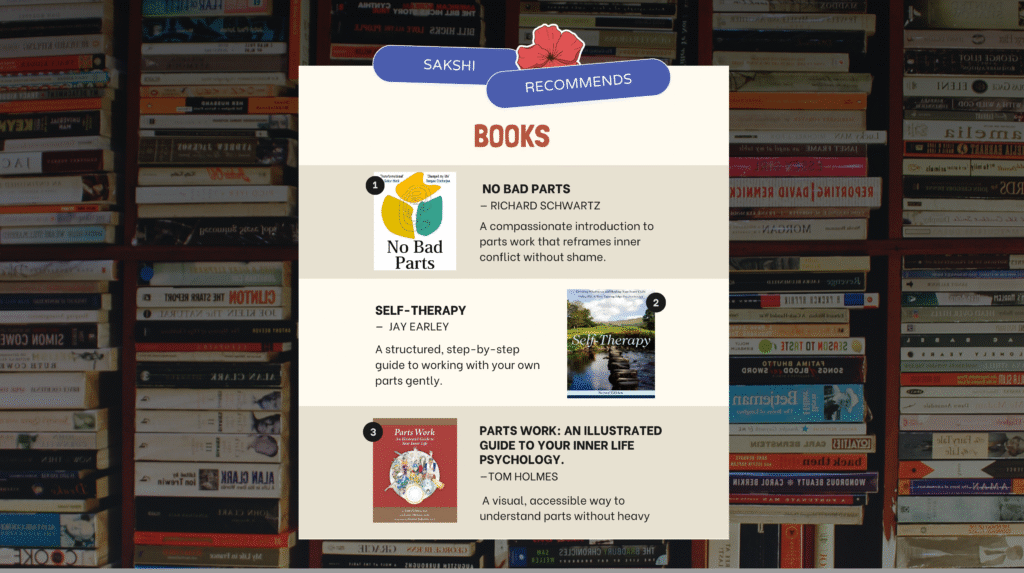
No Bad Parts - Richard Schwartz
This is usually the first book I recommend, and it’s also one I still return to.
What No Bad Parts did for me early on was shift the way I understood inner conflict. Instead of seeing certain reactions as things to fix, I began to see them as parts that had taken on protective roles for very real reasons. The tone of this book matters just as much as its content. It’s patient, non-judgemental, and deeply respectful of the nervous system.
I often tell people to read this slowly. If something stirs, pause. That’s part of the work.
Self-Therapy - Jay Early
This was one of the books that helped me move from understanding IFS conceptually to experiencing it internally.
Jay Earley offers structure without rigidity, which can be especially grounding for people who feel safer when there’s a clear process, particularly when exploring vulnerable inner material. This book can be grounding and I’ve seen it help readers feel less lost and more oriented when beginning to engage with their own parts.
It’s also a book I often see therapists revisit at different stages of their training.
Parts Work: An Illustrated Guide to Your Inner Life - Tom Holmes
This was the first book I started with. I tend to recommend this a lot, especially people like me who get easily overwhelm by heavy content and dense psychological language.
The illustrations do something important. They make parts work feel less intimidating and more embodied. Sometimes, seeing an inner dynamic drawn out can bypass the analytical mind and allow a softer understanding to emerge.
My parts love this book and it is a gentle companion rather than a manual.
Podcasts I Often Suggest to Clients, Enthusiasts and Students
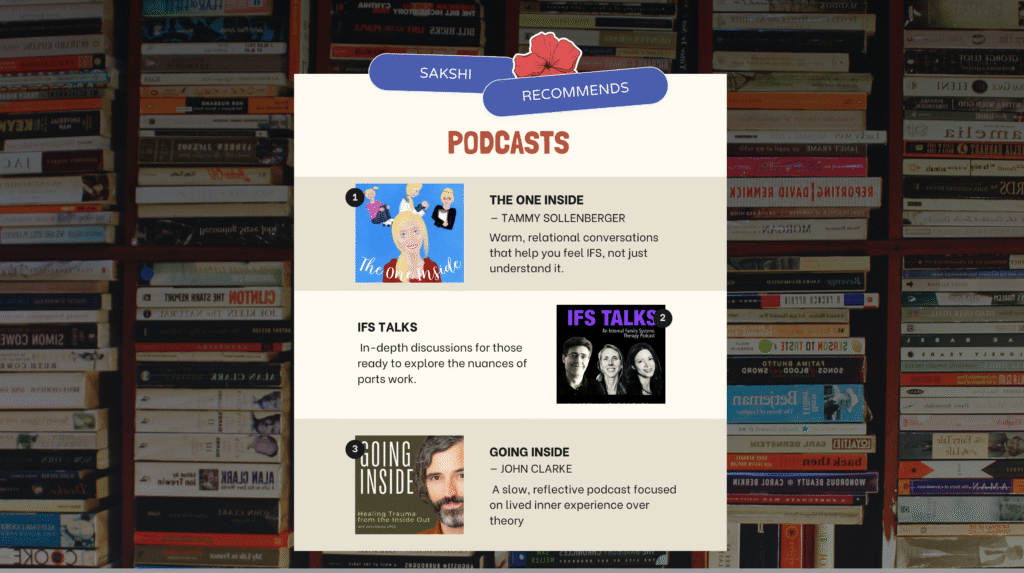
The One Inside - Tammy Sollenberger
This podcast is one I recommend often, especially to people who want to hear IFS rather than read about it.
Listening to conversations where parts are spoken about with care, curiosity, and respect helps internalise the tone of IFS. Tammy’s work consistently reflects the relational spirit of the model, which I think is just as important as understanding the concepts.
IFS Talks
IFS Talks is something I usually recommend once someone has some familiarity with the model.
The conversations here are richer and more nuanced, and they often explore subtle dynamics within parts work. For therapists, trainees, or serious enthusiasts, this can be a valuable way to deepen understanding.
I’d suggest listening in small doses and noticing what lands.
Going Inside with John Clarke
Going Inside stands apart from many IFS podcasts by slowing the work down. Rather than focusing on teaching concepts or techniques, it centres lived experience. How parts are felt, met, and related to in real time. It’s especially resonant for listeners who want to sense the work internally, not just understand it intellectually.
Best approached as a reflective listen rather than background learning.
Creators Whose Work I Respect and Learn From
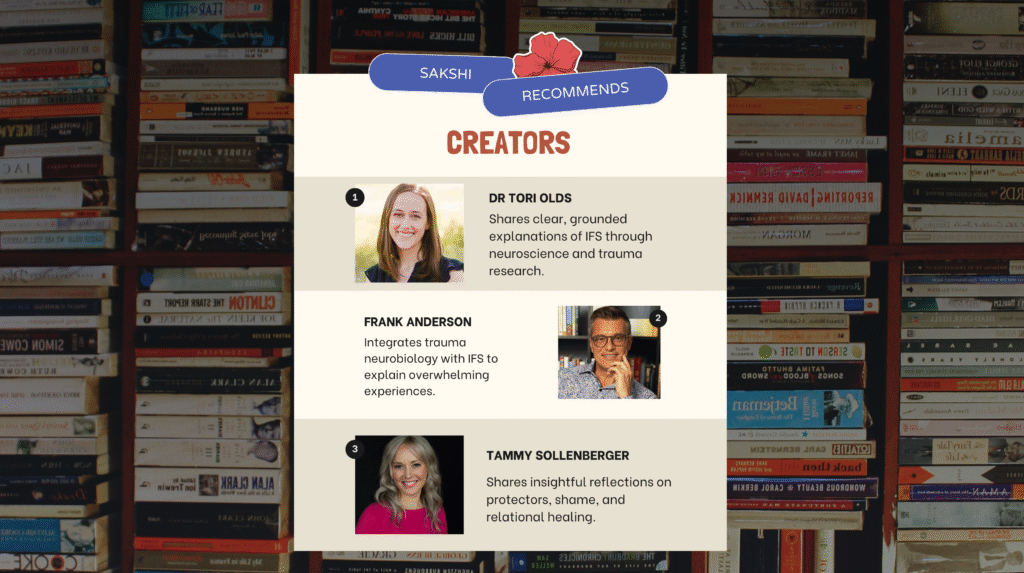
Dr Tori Olds
I often point people toward Dr. Tori Olds when they want to understand why parts behave the way they do. Her ability to integrate neuroscience, attachment, and trauma with IFS makes the model feel grounded rather than abstract. Her work helps many people contextualise parts responses without pathologising them.
Frank Anderson
Big fan of Frank!!!While not all of his content is purely IFS-focused, his trauma-informed perspective is incredibly valuable, especially for understanding how protectors develop in response to overwhelming experiences. His work pairs well with IFS once you have some grounding in the model.
Tammy Sollenberger
Beyond her podcast, Tammy’s writing has a way of naming internal experiences that many people feel but struggle to articulate. Her reflections often speak directly to shame, protectors, and relational wounds with depth and gentleness.
Her work reminds me that language matters deeply in parts work.
A Thought on Pacing and Safety
One thing I’ve learned, both personally and in my clinical work, is that IFS can feel deeply relieving and, at the same time, surprisingly tender. Reading about parts or recognising yourself in the language doesn’t automatically mean you’re ready to work with everything that comes up.
And that’s okay.
You don’t need to access every part right away. You don’t need to unburden anything immediately.
And you don’t need to turn self-understanding into another project to complete.
What often feels most aligned with IFS, at least in my experience, is simply noticing what happens inside as you learn. Which parts feel curious and drawn in. Which parts feel cautious or sceptical. Which parts feel overwhelmed or want to slow things down.
That information matters and it tells you a lot about your system and what it needs right now.
Let that guide your pace.
A Gentle Note:
Hi, I’m Sakshi J Danwwar, a trauma-focused psychotherapist and Certified Level-2 IFS Therapist. I write about the inner systems we develop to survive, belong, and stay connected, particularly within South Asian cultural contexts, through the lens of Internal Family Systems therapy. The reflections shared here are drawn from recurring themes in my clinical work along with personal observation. Any examples are composite and not based on a single individual.