



When people first hear about Internal Family Systems (IFS), I often witness a reaction…curiosity mixed with confusion. I see this with clients entering therapy and with therapists newly encountering the model.
Some even ask, “So… are these parts real?” or, “Does this mean something is wrong with me?” or even rightly wonder “Am I supposed to feel this many things at once?”
And I see how these questions don’t come from resistance but from trying to make sense of a concept that speaks a very different language than most of us were taught…about emotions, identity, and healing.
But as I continue this work within this space, I’ve noticed certain misconceptions come up again and again, presented often as facts. Not because people aren’t listening, but because IFS often clashes with cultural messages we’ve internalised for years.
So, I felt it might be helpful to slow down and write through some of these misunderstandings here. Not to correct anyone, but to bring more clarity.
Myth 1
“IFS will make me more fragmented because it talks in parts”
This is one of the first fears people voice, especially those who already feel conflicted inside. If you’ve spent years trying to “pull yourself together” or be more consistent, the idea of talking about parts can sound like inviting more chaos.
But in practice, IFS does the opposite. It doesn’t create fragmentation; it names what is already happening internally. Most people already experience different emotional states pulling them in different directions. IFS helps these states relate to each other instead of letting them compete silently. Integration happens not by forcing unity, but by allowing all parts to be seen within one system without shame.

Myth 2
“Protector parts are blocking my healing”
Protector parts are often misunderstood as resistance. People say things like, “My anxiety won’t let me go deeper,” or “I shut down every time we get close to something important,” and assume something is wrong.
And in many South Asian families, protector parts take on roles early. The responsible one, the achiever, the peacemaker. These parts are rarely experienced as helpers; they’re experienced as constraints.
IFS understands protectors as intelligent responses to earlier experiences. These parts learned that certain emotions, needs, or expressions were unsafe, so they stepped in to manage life differently. When protectors are met with pressure or impatience, they usually become stronger. When they’re met with respect and curiosity, they often soften naturally.
Healing happens through relationships, not force.
Myth 3
“Blending with parts is bad.”
Often I notice people feeling ashamed and feel bad that they get blended with their parts often. Well it’s so common and natural, our goal is not to be in Self all the time and I don’t think it’s impossible every time. It’s about being Self- led.
Many people, especially those raised in cultures where emotional control was valued, interpret blending as weakness. We can see blending as a normal part of being a human, often parts get blended to be seen and express themselves well. That’s the sign that they need some attention and expression.The work isn’t to stop blending altogether, but to notice it without panic or self-judgment.
Myth 4
“Parts are just imagination or role-play”
Some people worry they’re making things up, especially if they’re more rational or analytical. They assume parts work is symbolic rather than real.
But in reality, parts show up long before we name them through bodily reactions, emotional shifts, urges, and patterns that repeat despite insight. IFS doesn’t invent these experiences. It instead gives language to something people already live with but struggle to describe. Naming parts often brings relief because it matches lived experiences.

Myth 5
“IFS is just another therapy model probably for people with severe trauma or dissociative disorders.”
IFS is often misunderstood as either just another therapy model or something meant only for people with severe trauma.
I don’t see it that way at all.
While IFS is often used in trauma work, it isn’t limited to extreme experiences. It’s for the everyday inner conflicts people live with:- The self-criticism, the people-pleasing, the emotional shutdown, the anxiety that shows up even when life looks fine from the outside. In fact, many high-functioning people find IFS helpful precisely because it explains why they can be doing “well” and still feel so conflicted inside.
It starts from the assumption that our reactions make sense, that behaviour is adaptive, and that no part of us is inherently “bad” or broken. For many people, that shift alone changes everything. The question slowly moves from “What’s wrong with me?” to “What happened, and how did I learn to survive?”
Myth 6
“The only goal of IFS is to unburden or heal exile parts.”
“Unburdening” is not everything in the IFS therapy. More than reaching to the steps of unburdening what’s more important is to learn that safety, trust and the relationship between Self and parts is the main work.
Sometimes the most healing is simply a part being seen, understood, and no longer alone.
Unburdening is a possible outcome, but do not take it as a target. Much of IFS work involves building safety and trust with protector parts and I feel every moment of deep Self to part connection somewhere seems to carry a bit of unburdening.
Remember:- Moving too fast toward vulnerable parts can recreate overwhelm and trauma rather than healing it.

Myth 7
“IFS is about my family or family members.”
The word family can be misleading, especially in cultures where family dynamics are already central.
IFS focuses on our internal family which is made up of you and your different parts who always work for your survival and protection. External family systems influence these dynamics, but this work is all about your inner relationships.
Myth 8
“IFS work is not somatic”
IFS doesn’t just talk about the body, it listens through the body.
Parts live in the body and often speak through it before they form words. Tightness in the chest, heaviness in the gut, numbness, agitation, a sudden drop in energy shows parts reaching out to get some attention.
In IFS, the body is not something we check in with later. It’s central.
Also, there is also a growing branch of Somatic IFS, which explicitly works with nervous system states, movement, breath, and body-based tracking. But even classic IFS is inherently somatic when practiced with depth and attunement.

Myth 9
“IFS lets me blame my parts and avoid responsibility.”
That’s not IFS, that’s being blended with a part. Self stays aware of consequences and takes responsibility, knowing that a protector was driving the behaviour.
For example –“I realised a part of me did this, I apologise and take full responsibility for the behaviour.”
This concern often comes up when parts language is misunderstood. IFS does not remove accountability but it deepens it without shame or guilt.
Understanding why a behaviour occurred does not erase its impact. It helps people take responsibility with more clarity and less defensiveness. When behaviour is understood rather than denied, repair becomes more possible.
Myth 10
"IFS means getting rid of your parts"
It’s actually the opposite. It’s all about welcoming, acknowledging and respecting each part and connecting with them from a place of compassion or curiosity. It’s about understanding why they exist, appreciating how they have been trying to protect you and helping them move out of their extreme roles.
Healing happens through relationship not removal. Parts don’t disappear they relax, integrate and regain balance when Self is present.
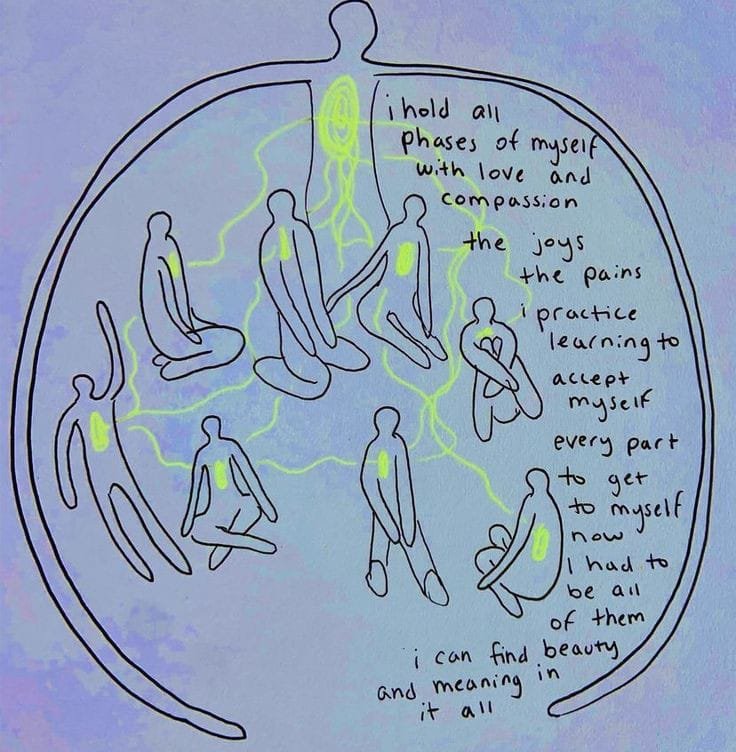
IFS doesn’t ask you to look inward because you’re broken. It asks you to look inward because there’s a system running inside you.
When that system is unseen, parts take over. They rush, freeze, please, control, or withdraw. Not because they’re dramatic, but because no one is listening.
IFS is what happens when listening begins.
As Self comes online, parts don’t disappear. They relax. Responsibility becomes clearer, not heavier. Repair becomes possible without shame.
This isn’t about trauma labels or deep excavation. It’s about learning how to stay present with yourself in everyday moments. Conversations. Decisions. Conflicts. Boundaries.
Over time, life stops feeling like a tug-of-war inside. Not because the parts are gone,
but because someone capable is finally leading.
Hi! I’m Sakshi J Danwwar, a Trauma-Focused Psychotherapist and a Certified Level-2 Internal Family Systems Therapist, Trainer and Supervisor. I work with individuals, couples and therapists to support deeper self-leadership in both life and practice. I write about the inner systems we develop to survive, belong, and stay connected, particularly within South Asian cultural contexts, through the lens of Internal Family Systems therapy. The reflections shared here are drawn from recurring themes in my clinical work along with personal observation. Any examples are composite and not based on a single individual.